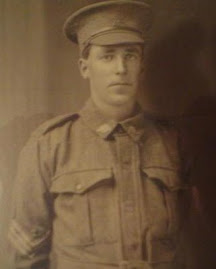
My Dear People,
Just a few lines to let you know I am quite alright. I came back from Furlough on Thursday after a most enjoyable and interesting trip.
When I got back I got 5 letters, one from Hilda Pohlner (Oct 14) one from Kath (Oct 14) 2 from Annie (Oct 14th & Nov 18th) and one from Nell (Nov 21st). In the last two you knew that I had been hit. I also got three parcels from home: one from Siss & George & one from Mt Bryan Red Cross circle. I was mighty pleased to get them as I had given up hope of getting them. I told you before that I had received the parcel with the waistcoat from the M.B.C. people. I wrote to Hilda thanking them but of course the mail route is a risky one now. I have sent you some books of views of Ireland & some Sinn Fien literature which I hope you get safely. I have got a lot of postcards and some little souvenirs to send yet but I don't want them to go on one mail.
I was very sorry to hear Frank Kelly and Charlie Burton were killed & I hope Ralph Thomas has been found alright. I think I will soon be going to Sutton Veney now as I told the doctor this morning that I was quite fit for France. You see I have had a real good time & I think it is nearly time I went back and done a bit more.
I will now give you a description of my trip through Ireland. I left Custon Station (London) Thursday night at 8.40pm and went right across England about 300 miles with only one stop at Crewe to Holyhead. I then got on the boat and went over the Channel in about 3 hours (it is 64 miles) and landed at Kingstown (Dublin), at 6 o'clock. I got in the train there and went straight to Killarney, arriving there at dinner time on Friday. Had a look over the Cathedral there. It has not been finished very long and I believe some priests went to Australia and collected a lot of money to help finish it. Saturday it was rather wet, so we went to see some lace at a convent in Killarney. They are on Red Cross work now as there is no market for lace. I got a couple of handkerchiefs or doilies which I am sending home to Mum. The lace is made by hand and the finer sorts are fairly expensive.
Sunday morning I went to Mass and then with another Corporal and a honeymoon couple, went in a jaunting car for a drive around the beautiful lakes of Killarney.
It is indeed lovely scenery. On Monday I went to a Fair at a little place called Killarglin (about 30 miles from Killarney). The people in this part are supposed to be the most backward and uneducated in Ireland but, I believe, as honest as could be. At the Fair there were cattle and people so thick in the street you could hardly walk through them. The crowd (girls & all) push and bump as bad as a lot of soldiers rushing for pay or dinner. There were a lot of cheap-jacks etc. They're much the same as a show in Australia. All the stock were bought and sold privately.
On Tuesday I went to Cork. It is a very old-fashioned town with about 100,000 inhabitants. There was a bit of a strike on there. A tobacco manufacturer there was paying the girls 3/6 a week for 10 hours a day and they struck. They had his place picketed and there were a lot of police there to keep order. The Irish police are very big, fine men and they do not want there to be any squibs either. I can tell you one afternoon they were escorting two or three fellows down the street and there was a mob of 200 or 300 chasing after them and boo-hooing something splendid.
At Limerick there was some trouble over a steam crane that was being put up. Some of the dock labourers thinking it would do them out of a job. One evening I was standing on the quay and a wagon belonging to the people putting up the crane was being escorted by about 20 police along the street. A yelling mob was following it. Some police who were guarding the yard rushed out with rifles and let the wagon in. Then the police rushed the mob and drove them off the quay like a mob of sheep. I take it that these are quite everyday occurrences in the poor misgoverned Ireland.
View Larger Map
On the Wednesday I went out to Blarney castle, about 10 miles from Cork, and kissed the Blarney stone. It is a very pretty place.
Thursday I went to Limmerick and then on to Dublin, Saturday night. I had not heard or seen much of Sinn Fein till I got to Limerick, but I went to a lecture there on the Dublin Rebellion by one of the men who was in it and sentenced to death, but was eventually released. I had my eyes considerably opened by what I heard and saw there. A good many of those present were in the uniform of the volunteer Republican Army. I did not think they would be allowed to wear that in public. They have officers and I saw a good bit of saluting being done by the privates. The Officers wear Shamrocks instead of stars on their sleeves. Some of the speaking was done in Gaelic and it is Sinn Fein's idea to get rid of everything English. Government, Language and all. I am afraid they are taking on a hopeless task. Any one of them would cut your throat for a rifle. So when the Irish soldiers come home on leave from France, the police take charge of their rifles till they go back. Of course everybody had their eyes on me but I clapped and hurrahed with the rest when they sang songs and gave recitations, some of which I have sent in a bundle of Sinn Fein stuff. It seemed a bit rich for me to be wearing a British uniform and cheering rank Sedition. I would have given quids to have had Uncle Jimmy with me.
Anyone I spoke to always wanted to know what part my grand-parents came from - but I do not even know what county they came from (terrible disgrace), you must write and tell me as it would be quite easy for me to trace some of my poor relations if I went to Ireland again. They also pointed out to me that it was on account of bad English laws that my people had to leave Ireland. But I don't bear England any grudge for that, seeing Australia has a climate more suitable for me to live in than Ireland. Dublin is a very nice little town with some lovely buildings and Phoenix park is a magnificent place.
The museum there has a wonderful stuff and I even saw some of our old South Australian stamps - it would take a week to go through it properly. The Art gallery is splendid too. I went over Guiness' Brewery - it is an immense industry. When you had had a look over the place they treat you to some of their stout, but I don't like any liquor much. Sackville street, which was knocked about a bit during the rebellion is still in ruins and the GPO is still the same.
I got back to London Thursday morning and went and saw the King's Guard change at Buckingham Palace (very smart) and then caught the train home after a most enjoyable fortnight.
The whole trip, fare and all cost me £14.0.0 and I came home with £11.0.0 in my belt as I did not intend to be short of money on my trip and I had everything I wanted and lived pretty swanky.
Well I must close now, hoping you are all well as I am.
I remain,
Your loving Son and Brother,
Tom
Showing posts with label furlough. Show all posts
Dublin; February 20, 1918
My Dear People,
Just a few lines to let you know I am quite alright.
I am leaving Dublin for London to-night. I should get into London at 6 o'clock to-morrow morning & will be back at Hurdcott tomorrow night. My leave is up at midnight to-morrow.
I have enjoyed my trip immensely and find Ireland a very nice place. You see they hardly know there is a war on over here and in England things are pretty different. In English towns you can hardly see your hand in front of your face at night, but here there are no lighting restrictions.
I am enclosing a P.C. with a packet of shamrock seed. They tell me they will not grow out of Ireland, but try them and see.
I am also enclosing an account of a breach of promise action. I have been told that during Shrove-tide it is often the custom between farming families to arrange weddings without consulting the wishes of the chief parties at all. The father of the girl paying £200 or £300 to the father of the boy, who must have a pretty decent farm and stock etc. If there is more than one boy in the family, the money is, I believe, divided among them and helps to start them in life. I expect Mum and Dad would have heard of this from their parents, but I did not know about this before. They also tell me that the priest's wedding fees differ according to your means - a poor man paying £5 or £6 and a wealthy man perhaps £20.
I have collected a nice lot of views and souvenirs of Ireland which I will pack and send them to you when I get back to England. I will try and send them by different mails so that some of them should reach you.
Hoping you are all quite well,
I remain
Your Loving Son and Brother
Tom
______________________________________
Newspaper clipping
A £400 Nest egg
Limerick Breach of Promise Action
Deal for a fortune
A commercial transaction says counsel
***********
Today at Nisi Prills, before Mr Justice Moore and a city common jury, a case of Reeves vs Kennedy was heard. The plaintiff, Mary Reeves, an infant, suing by her father John Reeves, a farmer of Ploughlands, Croom, Co Limmerick, sought to recover £700 damages for alleged breach of promise of marriage from the defendant, James Kennedy, a farmer of Ludden, Ballynesty, Co. Limerick. The defence was that the promise, if made was subject to a condition which was not fulfilled - namely the payment of a fortune - and that the promise was mutually rescinded.
Mr Serjeant Sullivan and a Mr Patrick Kelly (instructed by Mr P. G. O'Donnell) appeared for the plaintiff and Mr P. D. Fleming K.C. and Mr James Comyn (instructed by Messrs. W. Leahy and Son).
In stating the case Serjeant Sullivan said that the plaintiff was a very charming girl her parents occupying a good position as substantial farmers. Then defendant occupied an equally substantial position and was a most eligible partner for the lady. He had a farm absolutely unencumbered with supercilious relations (laughter). Not only had he a fine farm in the Golden Vein, but he was the owner of about 20 milch cows. He was a young man between 30 and 35 and well fitted to become the husband of the young lady. The parties met at Croom Races in 1916 and met frequently afterwards.
Although he was taken with her charms, there was a certain element of economy about him, because, before he finally committed himself to proposing to her, he ascertained that there was a little nest egg of £400 in the bank which he would get. The grey heads in the parish would say that the defendant was foolish in breaking away from tradition and select a girl after his own heart, with a comparatively small fortune, for he could have done much better from a monetary point of view.
The girl's friends were not going to take a pig in a poke and her father and some others went to inspect the defendant's place and they came to the conclusion that she was making a good investment for her £400.
On July 3, everything was arranged to the satisfaction of everybody. Defendant bought the wedding ring and six guineas present for the bridesmaid and the event was fixed for July 17. On July 11 plaintiff wrote to him to make arrangements with the priest and he replied breaking off the match because of certain things that did not please him. He thought that he would not waste the ring so he married another lady.
The plaintiff a young lady of attractive appearance gave evidence bearing out the statements of her counsel. She added that she had bought the trousseau in preparation for the wedding.
Mr Fleming suggested in the course of cross-examination that it was a commercial transaction and that the match was broken off because the girl's father was "shifting" in reference to the fortune.
Evidence was given by plaintiff's father that when he offered the defendant a fortune of £100, the defendant replied "Oh you will give me another hundred". Witnesses remarked "you are a long time after the girl and you are getting enough. The defendant then consented to take £100. In cross-examination, witnesses denied that the £ 100 was to be paid in a solicitor's office by a certain day.
The further hearing was adjourned until tomorrow morning.
Labels:
1918,
arranged marriages,
Australian soldier,
digger,
furlough,
Ireland,
Shrove-tide,
world war 1,
WW1
Subscribe to:
Posts (Atom)